Soil Testing and pH: The $20 That Makes Everything Else Work
By the TurfTrigger team · Reviewed against university-extension sources · Last reviewed July 16, 2026 · Our timing models
Lime, sulfur, phosphorus, potassium, iron: every one of those decisions is a bet on soil chemistry you have probably never measured. If the chemistry is off, and the most common wrong number is pH, a real fraction of what you spread this year will do nothing: nutrients chemically locked away from roots, iron applied to a lawn that cannot absorb it, fertilizer feeding a deficiency that is not the actual problem. A lab soil test costs about as much as one bag of fertilizer, and it is the purchase that keeps the amendment purchases honest. It will not time your pre-emergent or diagnose your grubs; what it owns is the pH and fertility half of the game, and that half is where the most money gets wasted blind.
What pH does to your fertilizer
Soil pH measures acidity on a 0-to-14 scale, and it acts on nutrient availability like a set of valves that open and close gradually, not switches that flip at a magic number. Most turf nutrients are at their most available in the slightly-acid band around 6.0 to 7.0. The further below about 5.5 the soil drifts, the more phosphorus gets tied up and the more aluminum starts pestering roots. The further above about 7.5, the harder iron and manganese are to absorb: the classic alkaline-lawn symptom is a yellowing lawn that shrugs off nitrogen, because the missing nutrient is iron the soil is holding hostage.
The point people miss: pH problems look like fertilizer problems. A pale, weak lawn on soil well outside its grass's band is a pH problem first, and until the pH moves, part of every feeding is wasted. The catch is that "outside the band" depends on the grass: a reading of 5.2 says lime under a tall fescue lawn and says nothing at all under centipede. Match the number to your species before you buy anything, which is where the exceptions come in:
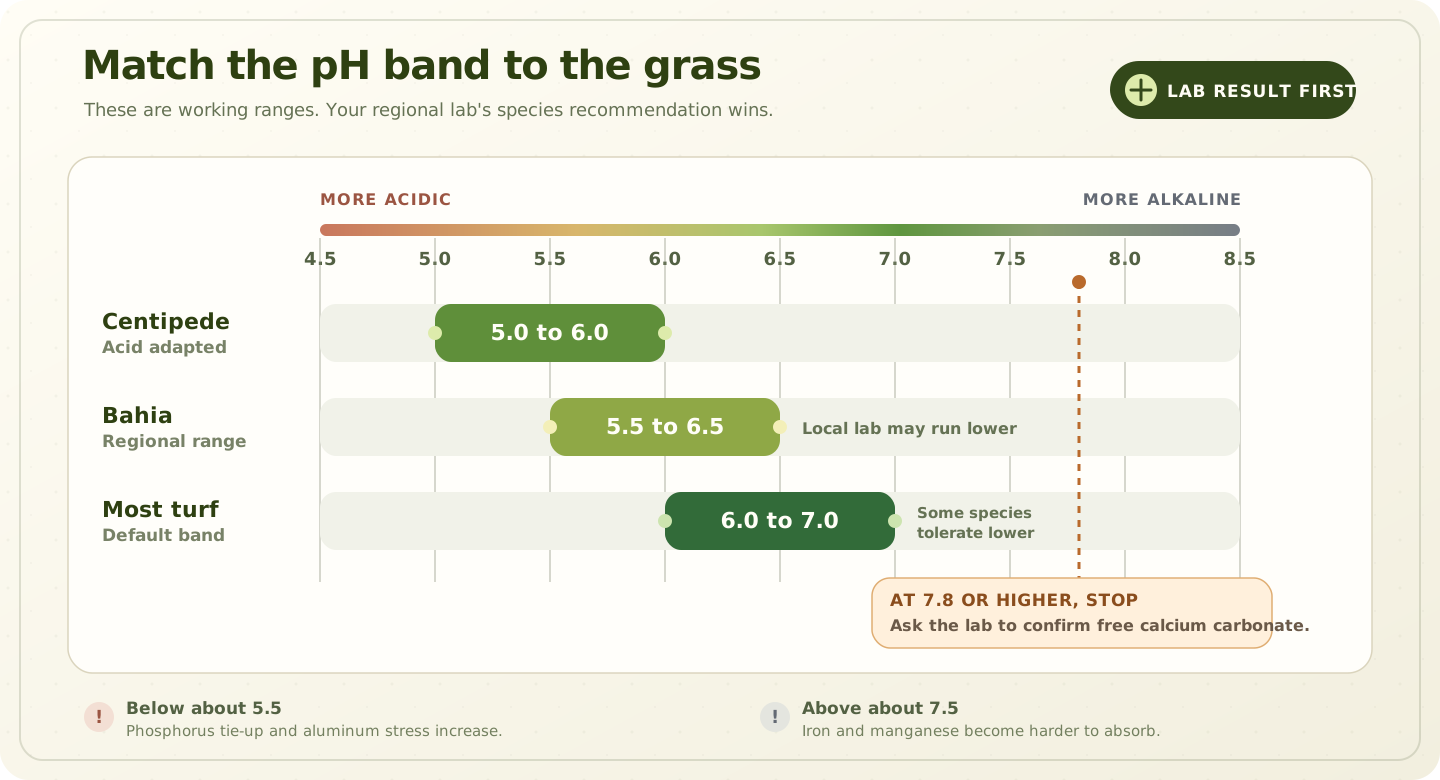
- Centipede wants genuinely acid soil, 5.0 to 6.0. Liming a centipede lawn "up to normal" is a classic killing-it-with-kindness move: as pH climbs past its band, iron availability falls and the risk of chlorosis and decline climbs with it. If a generic report tells you to lime centipede to 6.5, do not spread anything yet: the usual culprit is a recommendation calculated for the wrong crop, so confirm centipede was entered as the grass and get the number recalculated.
- Bahia is acid-adapted too. We use 5.5 to 6.5 as a broad working band, but regional labs run lower, and Florida's extension targets 5.0 to 6.0. Your local lab's species target wins.
Everything else (bermuda, zoysia, St. Augustine, and the cool-season grasses) does well in the 6.0-to-7.0 band. Treat that as the default, not the full tolerated range: several of those species run fine a half-point lower, which is one more reason the report's species-specific recommendation beats a generic chart.
When to test, and how often
Every 2 to 3 years is the honest cadence for an established lawn that is testing in range; soil chemistry moves slowly. The exception is a lawn mid-correction: while you are actively moving pH or feeding a documented deficiency, test annually, because the re-test is what tells you whether round two is needed.
Timing within the year: test ahead of your biggest feeding season, with enough lead time for amendments to act. Lime in particular is slow, taking months to move pH. In practice: cool-season lawns test in late winter through April (so lime can work before the fall feeding push), and warm-season lawns test in January or February in the Deep South, ahead of the summer feeding season. The worst time is right before you need the answer.
Use a real lab. Your state extension service runs soil tests for roughly the cost of lunch and returns numbers calibrated to your region. The hardware-store options are not that: in an Oregon State comparison, cheap probe meters could not reliably tell apart soils two full pH points from each other, and color-capsule kits are rough screening at best. A lab report typically gives you pH, phosphorus, potassium, often organic matter, and a recommendation, which is everything this page runs on.
Sampling is the part you can ruin. The lab measures what is in the bag: pull 10 to 12 plugs from around the lawn (a zig-zag walk), 3 to 4 inches deep, skip weird spots (next to concrete, the dog's corner, under the bird feeder), mix them in a clean bucket, and send in the blend. Keep grass and thatch out of the sample, and if your lab's instructions call for a different depth or count, the lab's instructions win. One plug from one spot is a test of that spot, not your lawn; likewise, a visibly different area (the boggy side yard, last year's new sod) earns its own bag.
Reading the report
pH below your grass's band → lime, at the report's rate. The lab's number, not a rule of thumb, sets the pounds, because how hard soil resists pH change (its buffering) varies with texture and organic matter: two lawns at the same pH can need very different rates. Use dolomitic lime when the report also shows low magnesium, calcitic otherwise; pelletized either way, applied any time the ground is workable. Two rules keep it safe: cap a single application at about 50 lb per 1,000 sq ft (a big correction is two applications months apart, not one heavy one), and re-test before round two rather than assuming. Lime takes months to produce a measurable move, and surface-applied lime on established turf works down even slower, so do not chase a big pH jump in one season: that is how lawns overshoot.
pH above the band → elemental sulfur, carefully, with two exceptions. Sulfur is slower than lime and easier to overdo, so our ceiling is conservative on purpose: no more than 5 lb of elemental sulfur per 1,000 sq ft in one application (the maximum UGA allows on mature turf, with foliar burn possible even there), no more than twice a year, and never in mid-summer heat, since the reaction is microbial and hot-weather applications risk burn. Gentler beats faster: repeated smaller doses, watered in off the leaves, with a re-test before committing to another round. Exception one: centipede and bahia may already be in range where other grasses read "acid." Exception two: if your pH is 7.8 or higher, stop before you buy anything. Soil that alkaline is often calcareous (free limestone or shell in the profile, common across Texas, Florida, and the desert Southwest), and calcareous soil holds so much carbonate that affordable sulfur cannot move it. But the number alone does not prove it: high readings also come from past over-liming or alkaline irrigation water, which sulfur can address, so ask your lab to check for free calcium carbonate before you decide. If it is truly calcareous, skip the sulfur war and manage around it: chelated iron sprays put the locked-out nutrient straight on the leaf and are the backbone of the program, alongside fixing anything else keeping roots weak (soggy or compacted ground makes chlorosis worse). And iron will not stand in for nitrogen if nitrogen is what is actually short.
Phosphorus: default to none. Established turf almost never needs added phosphorus, runoff feeds algae blooms, and a number of states (Maryland, New Jersey, New York, Minnesota, Wisconsin, Illinois among them) restrict lawn phosphorus by law, with scope and exceptions that differ state to state (some cover every homeowner, some only paid applicators). The two times P is on the table: your test says LOW, or you are establishing new turf. Even the seeding case is narrower than the starter-fertilizer aisle implies: several state laws exempt brand-new lawns and repairs but not routine overseeding, so check your state's current rule before assuming. This is exactly why the test matters: "low P" is a lab finding, not a guess.
Potassium low → fix it, without the mythology. Adequate K is real work: it runs the plant's water regulation, and turf short on it handles drought, disease, and winter stress worse. What extra K beyond enough does not do is armor the lawn further; this is a correct-the-deficiency play, not a more-is-better one. Fold the report's recommended amount into your grass's normal feeding schedule; sulfate of potash is the gentle source.
Organic matter is context, not a to-do: low single digits is normal for most lawns. Mulching clippings nudges it the right direction for free.
FAQ
My lawn looks fine. Do I still need a test?▸
"Fine" on unknown chemistry means you are getting away with it, and the test is how you find out how much margin you have. And if something is chronically off (pale color that nitrogen never fixes, moss, thin patches that reseed and die), the test is the first half of the diagnosis: it rules pH and fertility in or out. If those come back clean, the answer lives in the other half: irrigation, shade, compaction, disease, insects, or a grass that does not fit the site.
Can I just apply lime every year like my grandfather did?▸
Annual blind lime is how lawns end up ABOVE the band with iron locked out, and on centipede, repeated unneeded lime can weaken the lawn into outright decline. Lime is a correction, not a ritual. Test, correct, re-test.
The report recommends more nitrogen than my plan calls for.▸
Soil tests cannot hold a reading on nitrogen (available N changes week to week), so lab N lines are usually generic per-crop defaults, and nitrogen is the number your grass type, region, and season decide best. Take the pH, P, and K seriously; sanity-check the N line against your grass's actual program rather than swallowing it or ignoring it outright.
How does TurfTrigger use this?▸
Your season plan places the soil-test reminder in the right month for your grass and zone, timed so amendments can act before your biggest feeding season. Bringing the test's actual numbers into the app, so your plan reacts with lime or sulfur rates and a phosphorus gate automatically, is on the roadmap; today, this page plus your extension lab report cover the decision.
Sources
- UGA Extension, Turfgrass Fertility: Soil Texture, Organic Matter, Aeration, and pH (C1058-1) (species pH table, 50 lb lime cap, centipede lime warning, 5 lb sulfur ceiling and re-test-before-a-third guidance)
- UF/IFAS, Soil Testing and Interpretation for Florida Turfgrasses (SS317) (what turf soil tests can and cannot tell you)
- UF/IFAS, Fertility Considerations for Sod Production (SS164) (Florida pH ranges by species: bahia and centipede 5.0 to 6.0)
- UGA Extension (Appling County), Centipede Grass Decline (over-liming, iron chlorosis, and decline)
- Clemson HGIC, Centipedegrass Maintenance Calendar (centipede pH and sulfur practice)
- NC State Extension, Soil Sampling for Lawns, Gardens, and Landscapes (composite sampling method and depth)
- Oregon State Small Farms, Measuring Soil pH (lab testing vs. cheap probes and color kits)
- Colorado State Extension, Changing Soil pH (buffering, lime requirement, why free-lime soils resist acidification)
- NDSU Extension, Interpreting Soil Test Analysis for Turfgrass (potassium interpretation, high-pH management)
- UMass Extension, Soil pH and Liming (pH and nutrient availability)
- Rutgers NJAES, Turfgrass Fertilization (FS633) (nitrogen programs by species and season)
- Maryland Dept. of Agriculture, Lawn Fertilizer Law and NY DEC, Lawn Fertilizer FAQ (phosphorus restrictions and establishment exceptions)
See where this lands in your season
Timing beats technique. See the month this task belongs in for your grass on the free grass-and-zone schedules, or enter your ZIP for your soil temperature today and whether the pre-emergent window is open.