When a Second Fall Pre-Emergent Application Helps
By the TurfTrigger team · Reviewed against university-extension sources · Last reviewed August 10, 2026 · Our timing models
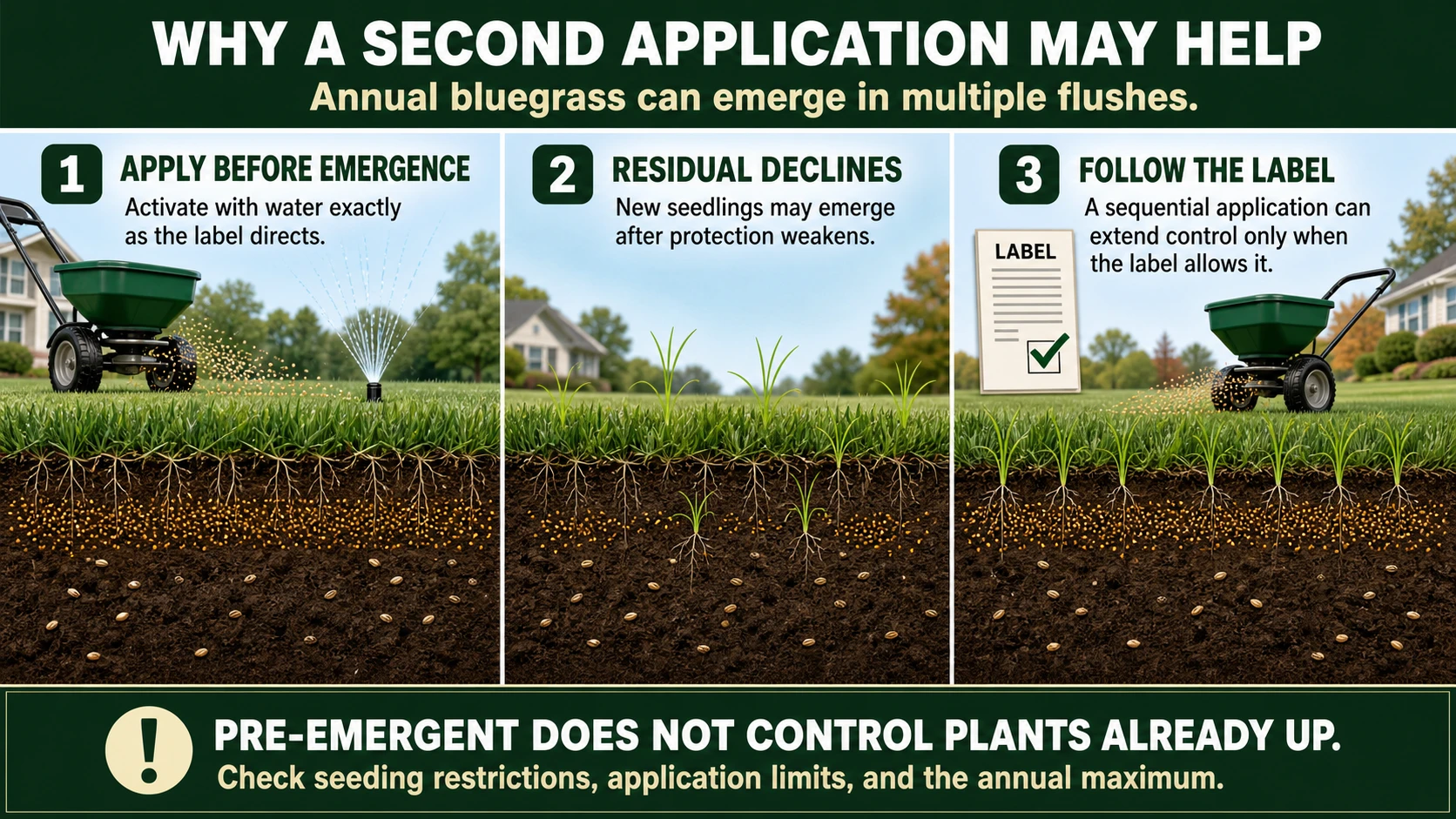
Annual bluegrass does not all germinate at once. It emerges over an extended period, and a pre-emergent does not stay active in the soil that long. Because of that, some lawns lose protection before emergence ends.
A label-approved sequential, or split, application can extend control where annual bluegrass breaks through year after year: not a stronger dose, and not a second chance at the same weeds, but replacement coverage laid down before the first application wears out. It is not automatically the right call on every lawn. One correctly timed full labeled application is enough where pressure is low, where the emergence season is short, or where your product and rate carry sufficient residual.
Whether your own lawn needs one, and when, is a question your product's label answers. This page explains the reasoning so that the label makes sense when you read it.
Planning to seed or overseed this fall? Read the label's establishment restrictions before you buy anything. Most annual-grass pre-emergents also stop desirable grass seed from establishing, and the waiting period varies by product and rate. In cool-season lawns, late summer and early fall are prime seeding windows, so the two jobs collide directly. If you are renovating, that decision comes first.
How long the germination window runs
The number that matters comes from a four-year study at two Maryland golf course roughs. Researchers counted annual bluegrass seedlings as they emerged and found emergence running from August all the way through May. Peak germination landed in early October, and between late September and mid-October they saw 50 to 70 percent of the season's seedlings.
Read that peak figure the other way around and you have the problem. In that study, 30 to 50 percent of the seedlings emerged outside the late-September-to-mid-October peak. Some came up in August. Much of it came up well into winter.
Two honest caveats about that number. It comes from two golf course roughs in Maryland, and the authors are explicit that it should not be extrapolated far beyond Maryland or similar environments. It also measured when seedlings emerged, not how well any herbicide controlled them. Your own peak will sit somewhere else on the calendar, and the split will be wider or narrower.
What travels is the shape, not the percentages. Across several studied regions, annual bluegrass commonly emerges in multiple flushes over an extended cool-season period rather than in a single event. The start, peak, and duration still vary with climate, moisture, site conditions, and the local population, and that is the fact the rest of this page rests on.
Why one application may not cover it
Pre-emergent herbicides have to be present in the zone where seed germinates and roots, and activated as the label directs. A seedling that grows into treated soil dies before it reaches the surface. The herbicide does not affect seed it never reaches, it does not control plants that are already up, and it does not last forever.
How long it lasts is rate-dependent, and the label says so. Prodiamine at a higher labeled rate holds longer than the same product at a lower one, which is why no honest source gives a single number for "how long pre-emergent lasts." Persistence also depends on the active ingredient, activation, soil conditions, moisture, and time. Rain or irrigation is often required to activate the product, while prolonged saturated soil can shorten how long some herbicides persist. Prodiamine in particular binds strongly to soil and is not readily leached, so do not assume a heavy rain washed your application away. Check the label rather than guessing from the weather.
So a second application is a maintenance job. You are not doubling up, and you are not applying a stronger dose. You are replacing coverage that is expiring while the weed is still germinating.
The timing, and why the second one is not a temperature call
The first fall application is timed by soil temperature. Risk rises as soil cools into the upper 60s in many warm-season and transition-zone settings. Published guides quote different numbers because they use different depths, averaging periods, and regional conditions, so treat them as planning signals rather than universal germination switches: the product has to be down and activated before your local emergence period, not when it arrives.
This is worth being precise about, because a lot of advice still says "apply at 70 degrees." Waiting for one exact number is late at many sites. If you wait for it, you may be applying into a lawn that has already started growing the weed you meant to prevent.
The second application is different in kind. It is timed by interval, not temperature, and the interval comes from your product's label, not from a rule of thumb.
That distinction matters more than it sounds. Published intervals vary widely because they describe different programs, different turf species, and different weed pressures. They are not interchangeable, and averaging them into a single number is not agronomy. Read the sequential-application instructions on the label for the product actually in your spreader, and use its interval and its annual maximum.
The reason it is an interval at all is the reason the second application exists. You are tracking the herbicide running out, not a new event in the plant. There is also no validated universal soil-temperature trigger for a second application, and soil can warm back through the same bands during a fall or winter warm spell. If your exact label permits a follow-up, its interval, per-application limit, turf restrictions, and annual maximum govern the decision.
One caution about deadlines you may encounter. Late-winter cutoff dates circulate in fall Poa discussions, and they are frequently attached to the wrong product. The commonly quoted "before February 1" deadline, for example, comes from Arizona guidance for a post-emergence treatment on dormant overseeded bermudagrass. It is not a general pre-emergent deadline, and it does not transfer to your product or your climate.
What is actually going on with annual bluegrass
Two things are worth understanding, and they are frequently blurred together in a way that is worth separating.
Annual bluegrass populations genuinely differ from one another. A study of eight ecotypes found significant variation in how they germinate in response to temperature and photoperiod, with the strongest germination at day and night temperatures of about 66°F and 50°F. Some populations flushed within roughly two weeks; others spread emergence across a month or more. Researchers describe hundreds or thousands of biotypes worldwide, sometimes several on a single golf course. Some of them even germinate in complete darkness, which is why a dense canopy alone will not stop it.
That variation is real and it is a good reason to cover a long window rather than a single date. It is not evidence that herbicide timing caused those differences.
One practical consequence is worth stating plainly: pre-emergent controls new seedlings only. It will not remove annual bluegrass that is already established, including the perennial-type plants that persist from one season to the next. If clumps come back in the same spots every year, timing a pre-emergent better is not the fix for those plants.
Herbicides do apply selection pressure, and in weed science generally that can shift a plant's timing. Repeated applications concentrated in one part of the season can favor plants that germinate outside it. This is documented across weed species as an escape strategy, and some herbicide-resistance mutations directly affect germination speed as a side effect.
What we will not tell you is that decades of 70-degree applications caused annual bluegrass to change when it germinates. That specific claim is plausible and it circulates widely, but the research showing biotype variation identified those populations by geography, not by what herbicides had been used on them. Nobody has demonstrated the causal chain. We would rather give you the fact that stands on its own: emergence runs August through May, and that alone justifies covering it properly.
What selection pressure has demonstrably done
There is one place where the evidence is not ambiguous, and it should change how you think about rates.
Annual bluegrass has become one of the most herbicide-resistant weeds in turf. A study published online in 2025 made it the first weed with confirmed field-evolved resistance to indaziflam applied both pre-emergence and early post-emergence. The resistant populations came from Oregon hazelnut orchards rather than turf, so the finding establishes a resistance risk in the species rather than a documented home-lawn failure. Annual bluegrass already carries documented resistance to multiple other modes of action.
The practical consequences are worth taking seriously:
- Use only the labeled rate for your target weed, turf species, and timing. Cutting rates to stretch a bag leaves survivors behind.
- Do not invent tank mixes, and do not alternate products between rounds, unless the exact labels permit that program for your weed, site, and turf species. Compatibility, turf tolerance, interval restrictions, and annual limits all have to line up, and that is a label question rather than a judgment call.
- Treat a control failure as information, but check the ordinary explanations first. Confirm the weed identification, whether plants had already emerged before you sprayed, your calibration and coverage, whether the product was activated, and the timing and rate. Repeated failure under correct use is when resistance becomes the credible explanation.
Never read "split" as license to apply the same thing twice at a reduced rate.
The rate ceiling: split does not mean more
This is the part that matters most for safety, so it goes in plain language.
Splitting an application does not increase how much product you may apply in a year. Pre-emergent labels carry a maximum annual rate per turf species. Prodiamine 65 WG labels, for example, commonly work out to roughly 0.83 to 0.84 oz per 1,000 square feet per year on bermudagrass and tall fescue. That figure is specific to that formulation and those turf species, so confirm the number on the label in front of you. Sequential applications are explicitly allowed on many labels, but only so long as the yearly total stays under the ceiling.
If you are applying pre-emergent in both spring and fall, all of those applications draw from the same annual budget.
Do not simply divide the annual maximum into equal applications. Labels commonly set several limits at once: a maximum for any single application, a minimum interval between applications, a cap on how much may go down within a shorter window such as 60 days, and the calendar-year total. Each one has to be satisfied independently, and you may have already spent part of the budget earlier in the year. Exceeding any of them risks turf injury, can damage root development, and is a label violation.
Your product's label is the authority here, not this page and not any app. Read the maximum annual rate for your grass type, and track what you have already applied this year before you apply again.
What TurfTrigger does, and what it does not
TurfTrigger times the first fall application for your ZIP code. It watches the five-day rolling average soil temperature together with the cooling trend, and it will not start the fall window during a warming stretch.
The window moves through two stages. Once the five-day average is at or below 80°F and confirmed cooling, the app marks the window approaching and tells you to get product on hand. When that average drops into the 70 to 76°F band, the window is active: this is the apply-and-water-in signal. Below 70°F the app treats you as late, because a pre-emergent alone no longer reaches plants that are already up.
Two honest limitations:
TurfTrigger does not remind you about a second application, and we are not going to fake it. When you tap "I applied," the app records a date. It does not record which product you used, at what rate, or over how much area, so it cannot tell whether another application would be useful, redundant, or over your label's annual limit. Timing a second round off a bare date would mean guessing at exactly the number that matters most, so we would rather tell you plainly that the label is the authority here.
That also means the app cannot track your annual budget. Spring and fall applications draw from the same yearly maximum, and only your own records show how much of it you have spent. Keep them.
If you are in USDA zone 3 or 4, the answer is conditional rather than automatic. TurfTrigger does open a fall window that far north, but it treats the application as a response to a problem you have actually seen. If annual bluegrass comes back in your lawn year after year, the reasoning on this page applies to you. If it does not, skip the herbicide. Spraying a preventive on a schedule for a weed you do not have is how resistance gets selected for on lawns that never needed the product in the first place.
FAQ
How long should I wait between the first and second application?▸
First confirm that your exact product permits a sequential application on your turf species. If it does, follow that label's interval, per-application limit, any short-period cap, and annual maximum. Do not shorten the interval on your own because the fall has been wet: prodiamine binds strongly to soil and is not readily leached, and any range on the label may be tied to rate or weed pressure rather than to your weather.
Does my product even allow a second application?▸
Not all do, and not on every turf species. This is the first thing to check, before the interval. Some labels permit sequential applications explicitly; others do not, and some restrict use on particular grasses entirely.
Is it too late if I missed the opening?▸
Not necessarily, but the advice changes. Once soil is below about 70°F, annual bluegrass is actively germinating, and a pre-emergent will not control plants that are already up. There is no generic pre-emergent-plus-post-emergent combination that is safe everywhere, so do not assemble one yourself. Any post-emergent has to be specifically labeled for your turf species, site, the weed's growth stage, and the conditions you are spraying in, and options differ sharply between grass types. Your local extension office can point you to something suitable. Emergence can also continue or resume through winter and spring in many climates, so a cold snap does not necessarily mean the season is over.
Do I need to split if I only get one chance?▸
One well-timed application at the full labeled rate is the priority, and on many lawns it is enough. A follow-up is what extends coverage into the back half of the season where emergence keeps going and your label permits it. If you only get one pass, apply and activate it ahead of your local emergence period rather than waiting for a specific number on a thermometer.
Does this apply to spring crabgrass pre-emergent too?▸
The principle is similar and split spring applications are also common, but the timing model is different. Spring pre-emergent timing draws on growing degree days, warming soil temperature, and local phenological indicators rather than on a cooling soil trend.
Can I just apply a heavier single rate to make it last longer?▸
A higher labeled rate can give longer residual where the label says so, but you have to stay inside every limit at once: the single-application maximum, the interval, any short-period cap, and the annual total. Going above those risks turf injury and violates the label. Rate alone also will not close a gap that runs months past your product's residual.
Sources
- Kaminski, J.E. and Dernoeden, P.H. (2007), Seasonal Poa annua L. Seedling Emergence Patterns in Maryland, Crop Science (four-year field study at two Maryland golf course roughs; emergence August through May; 50 to 70 percent of seedlings between late September and mid-October; peak in early October; authors limit extrapolation beyond Maryland and similar environments)
- Annual bluegrass (Poa annua) populations exhibit variation in germination response to temperature, photoperiod, and fenarimol, Weed Science (eight ecotypes; significant ecotype by environment interaction; maximum germination near 66°F day / 50°F night; germination in darkness)
- Carroll, D.E. et al. (2021), Current understanding of the Poa annua life cycle, Crop Science (biotype diversity; limits of the annual versus perennial classification)
- Miranda, M. et al., Poa annua becomes the first weed to evolve resistance to indaziflam applied preemergence and early postemergence, Pest Management Science (published online September 2025, 2026 issue; first confirmed field-evolved indaziflam resistance; populations collected from Oregon hazelnut orchards, not turf)
- University of Arizona Cooperative Extension, Annual Bluegrass Control in Non-Overseeded and Overseeded Turf (az1885) (sequential prodiamine at four to eight weeks; December sequential pairing; the before-February-1 deadline)
- Envu, Time for Fall Poa annua Control in Warm-Season Lawns (warm-season regional guidance: germination as four-inch soil reaches 72°F; split applications improve fall control. Manufacturer source: used for regional context, not as load-bearing support for universal timing or split-application claims)
- USGA Green Section, Monitoring Soil Temperature Improves Application Timing (professional warm-season turf context: germination below 67°F for five consecutive days, at that source's measurement depth and averaging period; soil temperature as an application trigger)
- Weed Seed Dormancy: The Ecophysiology and Survival Strategies, IntechOpen (herbicide timing as selection pressure on germination timing, as a general weed-science mechanism)
See where this lands in your season
Timing beats technique. See the month this task belongs in for your grass on the free grass-and-zone schedules, or enter your ZIP for your soil temperature today and whether the pre-emergent window is open.