When to Apply Pre-Emergent for Crabgrass
By the TurfTrigger team · Reviewed against university-extension sources · Last reviewed October 14, 2026 · Our timing models
Spring timing, soil temperature and modeled alert dates from U.S. cities. This guide is about spring crabgrass prevention; for fall pre-emergent and annual bluegrass, see the fall guide.
The short answer: apply a spring pre-emergent, and activate it with rain or irrigation as its label directs, before crabgrass seedlings emerge. Most crabgrass pre-emergents prevent newly germinated seedlings from establishing; they do little to plants already up. Our early cue is soil warming toward 50°F. Crabgrass germination gets going around 50 to 55°F, so waiting for 55°F can mean waiting until some seedlings are already out. The week that happens depends on where you live and moves by weeks from one spring to the next.
Check your ZIP's estimated spring window
Today's modeled soil temperature and heat units for your ZIP, and where the spring crabgrass window stands. No email needed.
Jump to your situation: not applied yet, already applied and then it turned cold, seeding this spring, or crabgrass already up.
Not applied yet: when to apply
Our early application cue is soil warming toward 50°F. Aim to apply and activate before the first seedlings emerge. Once seedlings appear, prevention can still target later emergence, but it generally will not control the plants already up.
Across the 28 cities we replayed (details below), the typical spring apply text ran from mid-January in Tampa (Brandon) to early May in Minneapolis and Omaha. By region, roughly:
| Region | Typical apply text in our replays, 2019 to 2025 | Example cities |
|---|---|---|
| Florida and the Gulf Coast | Mid-January to early February | Tampa (Brandon), Houston, New Orleans, Tallahassee |
| Southeast and North Texas | Early February to late February | Columbia SC, Atlanta, Birmingham, Raleigh, Charlotte, Jackson MS, Collierville TN, Dallas |
| Transition zone and mid-Atlantic | Early March to late March | Richmond, Nashville, Charleston WV, Little Rock, Louisville, Oklahoma City, Silver Spring MD |
| Ohio Valley and Lower Midwest | Early April | Columbus, Indianapolis |
| Great Lakes, Northeast, upper Midwest and Plains | Mid-April to early May | Chicago, Detroit, Boston, Milwaukee, Minneapolis, Kansas City, Omaha |
These are simulated alert dates, not observed emergence, and a typical date is not a forecast. Check your own ZIP above for this spring.
Applying earlier gives you more time to get the product down before emergence, but protection may end before later seedlings appear. How early is reasonable depends on the product, the rate, your climate and whether the label permits a follow-up application.
Soil temperature: what to watch
Crabgrass seed responds to the temperature of the soil it sits in, not to the calendar or one warm afternoon. The numbers you will see in extension advice are measured in different ways. Penn State describes the upper inch of soil at daybreak; NC State works from daily mean soil temperatures. They are not interchangeable, so compare a reading only with advice that used the same method.
TurfTrigger uses a five-day average of modeled soil temperature at about 6 centimeters, a little over 2 inches. That smooths daily swings, but a new reading can still move the average across a timing threshold.
One ZIP number cannot describe every patch of a yard. Soil along sidewalks and driveways, on south-facing slopes and in thin turf warms first, and that is where crabgrass usually shows first. Shaded, dense turf lags. If your lawn has warm edges, plan on those.
Already applied, then it turned cold
A cold snap after you apply does not by itself mean the application failed. Pre-emergents break down mostly through soil microbes, and cool soil slows them, so a barrier laid ahead of a cold spell generally waits it out. NC State has advised applying earlier for this reason. That is a general direction, not a guarantee for every product: check your label.
Long periods of waterlogged soil are one concern, because saturation can speed the breakdown of some pre-emergents and shorten protection. Uneven coverage, missed activation, the wrong product for the weed and poor application conditions are others.
What matters at the early end is also the ground when you apply. Labels commonly prohibit or warn against applying where water is standing or runoff is likely. Our texts screen for modeled signs of frozen, snow-covered or soaked ground and heavy rain due, and hold the "apply" text until conditions look suitable. That screen uses available weather data for your area. Missing readings do not automatically stop a message, and passing the screen does not establish that your yard is suitable for application, so look before you spread.
Crabgrass already up, or running late
If seedlings are already showing, you have two separate jobs. The first is the plants that are up. The second is everything that has not emerged yet, because crabgrass keeps germinating for weeks after the first seedlings appear. A pre-emergent still does that second job.
For the first job, some products help and most do not. The Preen dithiopyr label cited here describes early post-emergent control around the three-leaf stage, before tillering, and prohibits application more than four weeks after crabgrass germination. Other dithiopyr products can have different directions, so read the label of the product in your hand. Beyond that stage, you are choosing a post-emergent herbicide labeled for your grass, and the product catalog can help you compare.
Making it work: water in, label limits, splits
Activate it
Most pre-emergents need rain or irrigation to move them into the top of the soil. How much and how soon depends on the product. One prodiamine label we checked asks, for optimum control, for at least half an inch of rain or irrigation before germination and within 14 days. A dithiopyr label we checked words it differently and warns that control can be erratic without activation within 30 days. Neither timing is universal. For prevention, activate the product before the seedlings you intend to prevent emerge. Products labeled for early post-emergent control have additional directions for treating seedlings already present.
Rate, interval and the yearly maximum
The label is a legal document, and state or local law can add requirements on top of it. Rates, the minimum interval between applications and the yearly maximum all come from your product's label, and every application in the year counts against that maximum: spring, any second spring round, and fall.
Split applications
Some programs split the spring rate into two applications weeks apart, which can extend protection later into the season. It is a conditional benefit, not a promise of control through late summer, and only where the label permits it. For eligible split programs, a logged first application can trigger one TurfTrigger reminder to check the label, after at least 45 days. It is suppressed when the split is already complete or establishment restrictions apply. The reminder does not mean another application is due; the label sets the actual interval.
Seeding this spring
Most pre-emergents also stop grass seed from establishing, so seeding and pre-emergent in the same spring usually conflict. Some mesotrione and siduron products permit use when seeding specified cool-season grasses. Their species restrictions differ, especially for mesotrione with fine fescue or mixtures, so check the exact product label for both the seed mixture and the application timing. New sod and plugs have establishment restrictions too; check the label before treating them.
For cool-season lawns, fall is usually the better time to seed anyway. A spring preventer can also affect fall overseeding, so check its reseeding interval before choosing the spring product and rate. Your grass and zone schedule shows where seeding sits in the year.
Not every weed, and not every lawn
- This page times crabgrass. Other summer annual grasses run on their own clocks; goosegrass, for example, germinates later than crabgrass, so a crabgrass date is not a goosegrass date.
- Crabgrass timing can come before warm-season green-up. A preventer combined with fertilizer adds a separate feeding decision. If your warm-season lawn is still dormant and nitrogen is not yet recommended, choose a suitable product without nitrogen.
- A window is timing, not a prescription. It describes when prevention would work if your lawn needs it. A thick, healthy lawn without a crabgrass history may not need a pre-emergent every year.
How TurfTrigger times it
These are our operating choices, informed by extension guidance and the comparisons below. They are not universal biological thresholds.
- Northeast, Great Lakes, upper Midwest, mid-Atlantic, transition zone and Southeast (17 northern states from 39°N up, plus Maryland, DC, Virginia, North and South Carolina, Georgia, Alabama, Tennessee, Kentucky and West Virginia below about 2,500 feet): with both weather inputs available, our early timing rule uses 100 heat units and a five-day soil average of at least 50°F. Heat units here are growing degree days above 50°F counted from January 1 by the single-sine method, the method Ohio State's crabgrass phenology work uses. Application history, new-grass restrictions, the January policy and ground-condition checks can change or suppress the application message. The preparation alert uses a forecast of reaching 100 heat units within the next seven days; the application alert can come later if the soil check, the January policy or application conditions hold it back. In the southern states on this list, below USDA zone 8b we send no apply text before February 1; in zone 8b and warmer it can come in January, where regional guidance supports January applications. That is a policy choice, and a hardiness zone does not by itself decide when crabgrass emerges.
- Other seasonal-program locations in the lower 48, including the Plains, Texas, the Gulf Coast and Florida: our standard rule, 150 simple-average heat units, cross-checked against soil temperature, with a three-day settling rule. We provisionally retain this later rule in the Plains. In our Kansas comparisons it placed alerts closer to reported emergence, while the earlier rule provided substantially more lead time; those comparisons did not measure herbicide performance, so they cannot establish which rule produces better control. They do not validate the rule for Texas, the Gulf or Florida either, and Arkansas, Mississippi and Texas are open questions we are still checking.
- USDA zone 10 and warmer: crabgrass emergence can run much of the year, so we run pre-emergent as a program of rounds about three months apart instead of spring and fall windows. That is our program choice, not a universal need; product, weed pressure and label limits govern what you actually apply.
- Above about 6,000 feet, we present timing as an unvalidated estimate. Where a ZIP's elevation is unknown, we currently treat it as below these limits.
Ohio State's phenology calendar puts smooth crabgrass first seedling emergence at about 155 single-sine heat units. We treat that as a late-stage warning, not a deadline, and it carries the uncertainty of any model built at one site. Ohio State's own researchers found the degree-day models they evaluated inconsistent, off by anywhere from zero to more than 60 days, which is one reason we pair heat units with a soil check rather than relying on either alone. That finding does not establish how accurate our combined rule is. Full definitions are on our methodology page.
How much the date moves: seven springs in 28 cities
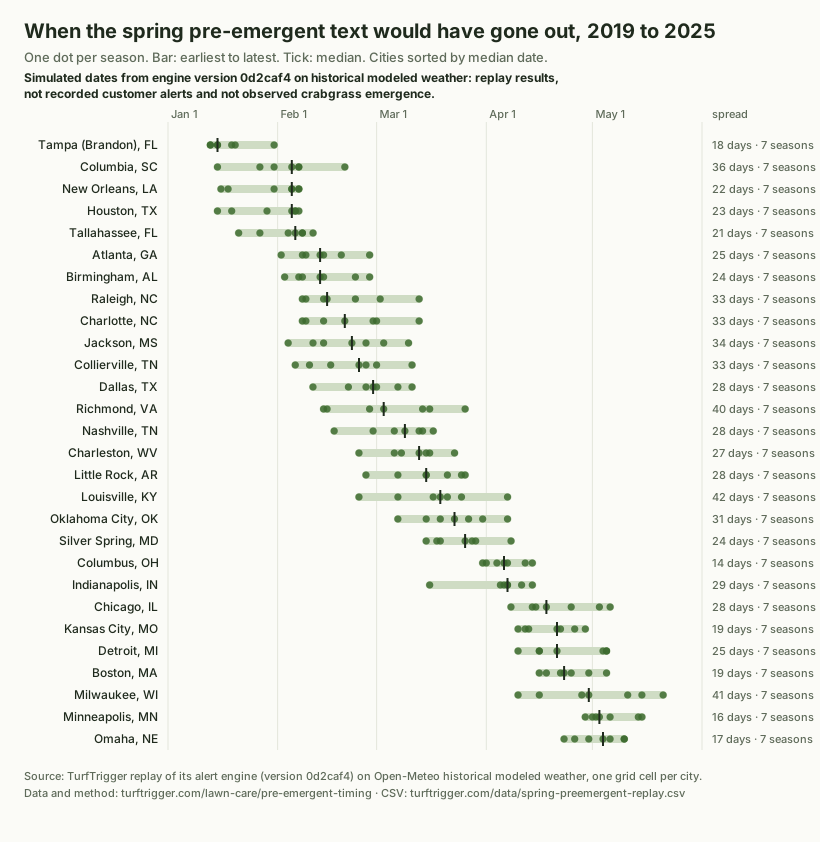
We replayed engine version 0d2caf4 (analysis run 2026-10-14) on historical modeled weather for 28 cities, every season from 2019 through 2025, and recorded the date of the first spring apply text. Every city has all seven seasons. The spread inside one city is the point: Louisville ran from February 24 to April 7 across those seasons, Milwaukee ran from April 10 to May 21, and Richmond ran from February 14 to March 26. Columbus was the steadiest, 14 days from first to last.
The same dates as a table (typical = the median season):
| City | Typical date | Earliest | Latest | Seasons |
|---|---|---|---|---|
| Tampa (Brandon), FL | Jan 15 | Jan 13 | Jan 31 | 7 of 7 |
| Columbia, SC | Feb 5 | Jan 15 | Feb 20 | 7 of 7 |
| Houston, TX | Feb 5 | Jan 15 | Feb 7 | 7 of 7 |
| New Orleans, LA | Feb 5 | Jan 16 | Feb 7 | 7 of 7 |
| Tallahassee, FL | Feb 6 | Jan 21 | Feb 11 | 7 of 7 |
| Atlanta, GA | Feb 13 | Feb 2 | Feb 27 | 7 of 7 |
| Birmingham, AL | Feb 13 | Feb 3 | Feb 27 | 7 of 7 (1 late) |
| Raleigh, NC | Feb 15 | Feb 8 | Mar 13 | 7 of 7 |
| Charlotte, NC | Feb 20 | Feb 8 | Mar 13 | 7 of 7 |
| Jackson, MS | Feb 22 | Feb 4 | Mar 10 | 7 of 7 |
| Collierville, TN | Feb 24 | Feb 6 | Mar 11 | 7 of 7 |
| Dallas, TX | Feb 28 | Feb 11 | Mar 11 | 7 of 7 |
| Richmond, VA | Mar 3 | Feb 14 | Mar 26 | 7 of 7 |
| Nashville, TN | Mar 9 | Feb 17 | Mar 17 | 7 of 7 (1 late) |
| Charleston, WV | Mar 13 | Feb 24 | Mar 23 | 7 of 7 |
| Little Rock, AR | Mar 15 | Feb 26 | Mar 26 | 7 of 7 |
| Louisville, KY | Mar 19 | Feb 24 | Apr 7 | 7 of 7 |
| Oklahoma City, OK | Mar 23 | Mar 7 | Apr 7 | 7 of 7 |
| Silver Spring, MD | Mar 26 | Mar 15 | Apr 8 | 7 of 7 |
| Columbus, OH | Apr 6 | Mar 31 | Apr 14 | 7 of 7 (1 late) |
| Indianapolis, IN | Apr 7 | Mar 16 | Apr 14 | 7 of 7 (1 late) |
| Chicago, IL | Apr 18 | Apr 8 | May 6 | 7 of 7 |
| Detroit, MI | Apr 21 | Apr 10 | May 5 | 7 of 7 |
| Kansas City, MO | Apr 21 | Apr 10 | Apr 29 | 7 of 7 |
| Boston, MA | Apr 23 | Apr 16 | May 5 | 7 of 7 |
| Milwaukee, WI | Apr 30 | Apr 10 | May 21 | 7 of 7 |
| Minneapolis, MN | May 3 | Apr 29 | May 15 | 7 of 7 (1 late) |
| Omaha, NE | May 4 | Apr 23 | May 10 | 7 of 7 |
"Late" marks a season whose first apply text was the closing-stage text, because a ground or rain hold lasted until the window was closing.
Two cautions when reading it. First, the chart compares our rules as well as climates: Kansas City and Omaha run the later Plains rule, which is part of why they land after Chicago and Detroit. Second, these are simulations, not observations. They show how our system's timing varies; they do not show when crabgrass emerged in those cities.
The data behind the chart, one row per city and season with the event, date, engine version and representative ZIP, is a CSV download. The reference lawn is tall fescue; the spring dates came out identical for a bermudagrass lawn in every city and season.
Our dates against reported emergence
Published, dated records of crabgrass emergence are scarce. These are the ones we could match to a site and season, replayed with engine version 0d2caf4. The gap compares our simulated alert with the emergence date or period reported by each source. The records differ: Wooster reports mean estimated dates of smooth crabgrass emergence across eight plots, Maryland used weekly counts, Mead reported a week for a stand that included large crabgrass, and Olathe is a dated photograph rather than a monitored first-emergence date. Bare-soil and turf records are kept separate because habitat can change emergence timing, although bare soil was not earlier in every study-year.
| Site and season | Where observed | Reported emergence date or period | Our apply text | Gap |
|---|---|---|---|---|
| Wooster OH, 2002 | Smooth crabgrass: turf (lawn plots) / bare soil | Apr 17 / Apr 18 | Apr 15 | 2 / 3 days before |
| Wooster OH, 2003 | Smooth crabgrass: turf (lawn plots) / bare soil | Apr 16 / Apr 20 | Apr 6 | 10 / 14 days before |
| Wooster OH, 2004 | Smooth crabgrass: turf (lawn plots) / bare soil | Apr 24 / Apr 20 | Apr 19 | 5 / 1 days before |
| Silver Spring MD, 1992 | Bare ground nearby / Turf (study plots) | Apr 26 / May 4 | Apr 11 | 15 / 23 days before |
| Silver Spring MD, 1993 | Turf (study plots) | Apr 26 | Apr 18 | 8 days before |
| Silver Spring MD, 1994 | Turf (study plots) | Apr 29 | Apr 10 | 19 days before |
| Manhattan KS, 1995 | Bare soil / Thin turf | Apr 15 / May 22 | Apr 7 | 8 / 45 days before |
| Manhattan KS, 1996 | Bare soil | May 9 | Apr 24 | 15 days before |
| Manhattan KS, 1997 | Thin turf | May 5 | May 2 | 3 days before |
| Olathe KS, 2020 | Bare soil by a sidewalk | Apr 19 | Apr 13 | 6 days before |
| Mead NE, 2011 | Turf (field trial) | First week of May | May 8 | After the reported week |
| Mead NE, 2012 | Turf (field trial) | Last week of April | Mar 28 | About 4 weeks before the reported week |
| Mead NE, 2013 | Turf (field trial) | Second week of May | May 17 | After the reported week |
An alert before reported emergence does not establish that a homeowner could apply and activate in time; these gaps measure alert timing only. Wooster and Silver Spring run our earlier rule; the Kansas and Nebraska sites run the later Plains rule. In Nebraska our later rule's alert came after the reported emergence week in two of three seasons; those misses are real, and the earlier rule would have given substantially more lead time there. The Nebraska efficacy trial also raises a residual-duration concern for very early single applications, but it did not test our alert thresholds.
These 18 habitat-specific records cover 13 site-years at five sites. They cannot settle timing for a whole region. Some of these observations informed our rule choices, so this is a retrospective comparison, not independent validation or a trial of homeowner weed control. We will add sites as dated observations turn up.
What this analysis can and cannot tell you
- Modeled weather, not a station. Replays and live checks both use modeled weather for a grid cell, which can differ from a backyard thermometer.
- Hindsight stands in for forecasts. The replay substitutes historical modeled weather for forecasts. It therefore knows the later archive values, unlike a live forecast, and does not reproduce historical forecast errors.
- No snow in the replays. The replay does not load snow-cover information, so it cannot simulate the snow hold. That does not mean those historical dates were snow-free.
- A slightly different soil layer. Replays use the archive's 0 to 7 centimeter soil layer; the live check reads about 6 centimeters. Both average the five days before the date in question.
- Your yard is not the grid cell. Microclimate, slope, shade and turf density shift the real date, as the section on soil temperature describes.
- The label always applies, along with any state or local rules where you live.
FAQ
What soil temperature should I apply pre-emergent at?▸
Our early cue is soil warming toward 50°F. Do not wait for a single 55°F reading: seedlings may already be emerging in warmer patches, and temperature guidance depends on how and where it was measured.
Is it too early to apply in February?▸
It depends on where you are. Across the Gulf Coast and much of the Southeast, our replays sent the apply text in January or February in most seasons. In the North, February is usually well ahead of it, and an application that far ahead may run out before emergence ends. Check your ZIP.
Can I apply pre-emergent right before rain?▸
Rain is how many products get activated, but follow the label: some want activation within a set number of days, and heavy rain soon after application or saturated ground can move product where you do not want it. Our texts hold the apply message when an inch or more of rain is forecast in the next 48 hours.
How long does a pre-emergent last?▸
It varies by product, rate and conditions, which is why labels list rates, intervals and yearly maximums, and why some programs split the spring application. Do not count on one application lasting all summer.
Can I put down pre-emergent and grass seed together?▸
Usually not with most pre-emergents. Some mesotrione and siduron products permit use when seeding specified cool-season grasses, with different species restrictions. Check the exact label for your seed mixture and timing.
Is it too late in May?▸
May can be too late to prevent the first crabgrass in many southern lawns, while some northern lawns may still be approaching emergence. Look for seedlings and check local timing. A labeled pre-emergent may still prevent later emergence, but plants already up need a separate control decision.
Sources
- Purdue University Turfgrass Science, Crabgrass Control (germination as soil reaches about 50 to 55°F; pre-emergent timing; limited early post-emergent activity of dithiopyr)
- Penn State Extension, Lawn and Turfgrass Weeds: Smooth Crabgrass and Large Crabgrass (soil temperature measured in the upper inch at daybreak; application before expected germination and watering in)
- NC State TurfFiles, Timing of Preemergent (PRE) Herbicide Applications for 2023: Apply Earlier (cool soil slows microbial breakdown; earlier applications)
- NC State TurfFiles, When to Apply Preemergent Herbicides for Turfgrasses (February germination in North Carolina in recent years; daily mean soil temperatures)
- NC State TurfFiles, Effect of Waterlogged Soil on Preemergence Herbicides in Turfgrass Systems (prolonged saturation can shorten protection from some products)
- Ohio State University, Growing Degree Days glossary (single-sine calculation, base 50°F) and phenology calendar (smooth crabgrass first seedling emergence at 155)
- Cardina, J., Herms, C.P. and Herms, D.A. (2011), Phenological Indicators for Emergence of Large and Smooth Crabgrass (Digitaria sanguinalis and D. ischaemum), Weed Technology 25:141-150 (Wooster OH mean estimated emergence dates 2002 to 2004 across eight plots; the degree-day models evaluated were off by 0 to more than 60 days)
- Fidanza, M.A. (1998), account of the University of Maryland crabgrass emergence research, TurfGrass Trends (Silver Spring MD dates 1992 to 1994, weekly counts)
- Reicher, Z.J., Sousek, M.D. and Gaussoin, R.E. (2014), Fall or Late Winter Applications of Preemergence Herbicides Rarely Provide Season-long Control of Crabgrass (Digitaria spp) in Nebraska, University of Nebraska (Mead NE emergence by week, 2011 to 2013; residual duration of early applications)
- Kansas State University, Research report SRP812 (selected Manhattan KS bare-soil and thin-turf emergence records, 1995 to 1997)
- Fry, J., Crabgrass Has Emerged, Kansas State University (Olathe KS seedlings photographed on bare soil by a sidewalk, April 19, 2020)
- Rutgers NJAES, Fact Sheet FS1309 (extended emergence; split programs; mesotrione and siduron at seeding on specified turf, with differing fine-fescue restrictions)
- UF/IFAS, EP141 (goosegrass germinates later than crabgrass; preventer and first-fertilizer timing differ)
- UC IPM, Special weed problems in turfgrass (germination much of the year in warmer California locations)
- Prodiamine 65 WDG label, EPA Reg. No. 53883-429, label dated June 5, 2025 (for optimum control, at least one-half inch of activation before germination and within 14 days; rate-dependent reseeding intervals)
- Preen Lawn Crabgrass Control (dithiopyr) label, EPA Reg. No. 961-417, label (activation within 30 days; early post-emergent control to about the three-leaf stage, not tillered plants; do not apply later than 4 weeks after crabgrass germination)
- U.S. EPA, Introduction to Pesticide Labels and Pesticide Labeling Questions and Answers (labels are legally enforceable; states can add restrictions)
See where this lands in your season
Timing beats technique. See the month this task belongs in for your grass on the free grass-and-zone schedules, or enter your ZIP for your soil temperature today and whether the pre-emergent window is open.