Trinexapac-Ethyl for Home Lawns: What PGRs Do and How to Time Them
By the TurfTrigger team · Reviewed against university-extension sources · Last reviewed July 16, 2026 · Our timing models
A plant growth regulator is a tool most homeowners have never tried, though it is standard on intensively managed golf turf. The idea sounds backwards: you apply a product so your grass grows LESS. What you may get in exchange is less vertical growth, fewer clippings, and improved color or density. The size of those benefits varies widely by grass, season, mowing height, fertility, and application program. The catch is timing: a PGR's schedule does not run on days, it runs on heat.
What a PGR actually does
The common lawn PGR is trinexapac-ethyl. It is a foliar-absorbed regulator that temporarily inhibits a late step in gibberellin production, reducing cell elongation and vertical shoot growth. It commonly reduces clipping yield and can improve color, density, or tillering under some programs. Lateral growth, rooting, and stress responses vary by grass, temperature, rate, and management, so deeper roots are not a guaranteed effect.
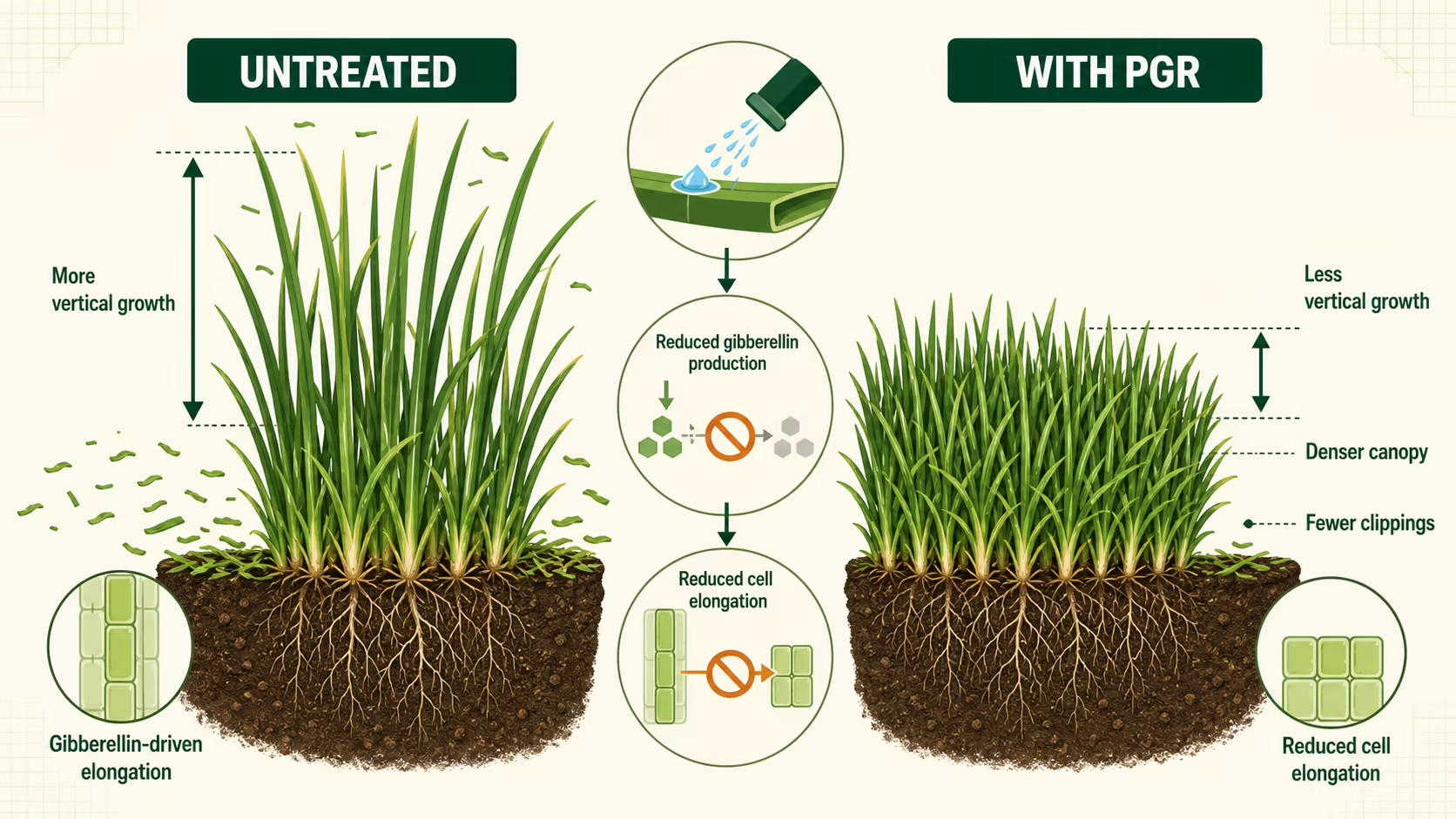
The practical results, in rough order of why people spray it:
- Less mowing. Trinexapac can extend mowing intervals, but the reduction varies widely. Some warm-season lawns approach a 50% reduction under suitable programs, while cool-season home-lawn results can be much smaller (a tall fescue study found only about 9% fewer mowings).
- Density. The redirect away from vertical growth can thicken the stand on bermuda and zoysia, though response depends on cultivar, fertility, mowing, sunlight, and program.
- Color. Treated turf often appears darker because vertical growth and clipping removal decline, and some programs improve measured color or chlorophyll. Do not count on deeper roots or reduced irrigation needs as automatic benefits.
The rebound, and why the schedule is everything
After suppression declines, some grasses and programs enter a rebound phase in which clipping growth exceeds an untreated comparison for a stretch, exactly the flush of soft vertical growth you sprayed to avoid. The effect is well documented but varies in strength, and some warm-season putting-green studies have shown little rebound. Reapplying with a validated GDD model can reduce the swing between suppression and rebound, but no interval eliminates variation in every lawn.
So when does regulation end? Not after a fixed number of days. Trinexapac-ethyl is metabolized by the plant, and the plant's metabolism runs on temperature: the active is metabolized faster in hot weather and lingers in cool weather. This is why serious users schedule PGR by growing degree days (GDD), accumulated-heat arithmetic like the kind TurfTrigger uses to time crabgrass germination.
Use a PGR-specific GDD model, not a universal home-lawn number. Published trinexapac intervals depend on the grass, mowing height, application rate, GDD base, temperature units, and management system. Creeping bentgrass putting-green research used about 200 GDD base 0°C, while ultradwarf bermudagrass putting-green research found about 216 to 230 GDD base 10°C. Those values are Celsius degree-days; expressed in Fahrenheit degree-days they are much larger (roughly 360 base 32°F, and about 389 to 414 base 50°F). Neither threshold is validated as a single rule for every home lawn.
Hot weather shortens the suppression period, while cooler weather lengthens it. A properly calibrated GDD model handles that change better than a fixed calendar interval. Always confirm the model's temperature base, degree units, grass, mowing height, and rate before using its threshold, and confirm performance from actual clipping growth.
Who should and should not bother
Good fit: bermuda and zoysia lawns mowed short, especially reel-mowed; anyone chasing density; large lawns where extending the mowing interval matters.
Cool-season lawns: tall fescue and bluegrass respond too, but results vary by species, season, growth rate, and mowing height. Kentucky bluegrass can show improved color, quality, and clipping suppression; tall fescue mowing reduction may be modest.
Skip it: stressed lawns. Extension recommendations call for actively growing, non-stressed turf, so a lawn in drought stress, disease pressure, or recovery from renovation needs its full growth engine. On overseeding, check the exact label: some trinexapac labels permit application to established bermudagrass one to five days before cool-season overseeding, because the active ingredient is absorbed through foliage and does not prevent seed germination. Do not apply over new seedlings or renovation areas unless your label specifically permits it.
How to run a program
- Start clean. Apply only to established, actively growing, non-stressed turf. For a first spring application, wait until the lawn has greened up and resumed regular mowing.
- Spray, do not guess. PGR goes out as a liquid at label rate for your grass; rates differ meaningfully between bermuda, zoysia, and cool-season turf. Use a calibrated sprayer, accurate measuring equipment, and the protective equipment required by the label. Measure the lawn, calibrate the sprayer with water, and keep walking speed, pressure, and coverage consistent.
- Track heat, not days. Log your application date and reapply on a PGR-specific GDD model matched to your grass, base temperature, and degree units, then confirm from actual clipping growth. Note that TurfTrigger's current GDD display is a seasonal crabgrass model (base 50°F, no per-application reset); it demonstrates the heat-accumulation concept but must not be reused as a trinexapac schedule.
- Expect a brief pause. Growth suppression develops after application. Temporary yellowing, blue-purple color, or other discoloration can occur, especially on stressed or sensitive turf or after an application error. Discoloration does not prove the error was mild, so recheck the label, measurement, and sprayer calibration before applying again.
- Land it deliberately. Late in the season, stop reapplying early enough that the lawn goes into fall unregulated (cool-season: before overseeding; warm-season: several weeks before expected dormancy, since late applications under cool conditions can reduce density and quality).
FAQ
Is this safe to have on the lawn with kids and pets?▸
Use only a product labeled for your lawn and grass. Follow its directions for protective equipment, mixing, drift control, reentry, storage, and disposal. Keep children and pets off the treated area for the full interval stated on that label.
Can I combine it with fertilizer and other sprays?▸
Keep the lawn on an appropriate fertility program and adjust only from its actual clipping growth, color, soil-test results, and label guidance. Do not assume trinexapac can be mixed with a fertilizer, iron, or herbicide. Tank-mix only when both labels permit the combination and all compatibility and injury precautions are satisfied.
Will it hurt my lawn long-term?▸
Growth suppression is intended to be temporary when trinexapac is applied at a labeled rate to healthy, established turf. Recovery time and injury risk vary by grass, rate, temperature, and application history. Repeated or poorly timed applications can affect color, density, recovery, and seasonal transition.
Does TurfTrigger schedule PGR for me?▸
Not yet. Trinexapac-ethyl is in our product catalog, but TurfTrigger does not currently calculate a PGR interval or send a PGR alert. Our existing GDD displays illustrate the accumulated-heat concept, but their base temperature, starting point, and thresholds are built for other events and should not be reused as a trinexapac schedule. A PGR alert keyed to a logged application is on the roadmap.
Sources
- Kreuser and Soldat, A Growing Degree Day Model to Schedule Trinexapac-Ethyl Applications (creeping bentgrass putting-green ~200 GDD base 0°C model; more consistent suppression than calendar scheduling)
- Reasor and colleagues, GDD Models for Ultradwarf Bermudagrass Putting Greens (temperature-dependent metabolism, warm-season base 10°C model, ~216-230 GDD interval, variable rebound)
- Cornell Turfgrass Program, Plant Growth Regulators (gibberellin inhibition, foliar absorption, suppression and rebound phases, temperature effects, GDD scheduling)
- USDA ARS, Trinexapac-Ethyl Affects Kentucky Bluegrass Root Characteristics (increased tillering and slight color improvement; challenges the guaranteed deeper-root claim)
- UGA Pest Management Handbook, Turf Growth Regulators (actively growing turf, temporary yellowing, home-lawn labeling, foliar absorption, application before bermudagrass overseeding)
- Kansas State, Trinexapac Effects on Tall Fescue Mowing Requirements (home-lawn-style tall fescue mowing reduction as small as ~9%)
- Lickfeldt and colleagues, Repeated Trinexapac Applications on Kentucky Bluegrass (clipping suppression, turf-quality response, rebound after longer intervals, no detected harm under one multi-year program)
- EPA, Trinexapac-Ethyl Human Health Review (low acute toxicity for the technical active; formulation-specific label, exposure, and reentry precautions still apply)
See where this lands in your season
Timing beats technique. See the month this task belongs in for your grass on the free grass-and-zone schedules, or enter your ZIP for your soil temperature today and whether the pre-emergent window is open.