Core Aeration: When and How to Aerate, by Grass and Zone
By the TurfTrigger team · Reviewed against university-extension sources · Last reviewed July 16, 2026 · Our timing models
Core aeration is real work that fixes a real problem, and it is usually scheduled by habit instead of by lawn condition. Every big-box calendar says "aerate in spring." For most cool-season lawns that is the second-best window, and for a warm-season lawn still waking up it is simply too early. The right date depends on what grass you grow and when it is growing hard, with enough good weather left to recover.
What aeration actually does
A core aerator pulls plugs of soil (about the size of your thumb) out of the lawn and drops them on the surface. Each hole does three things: it relieves compaction so roots and water can move again, it vents the root zone, and it brings soil microbes up into the thatch layer where they help break it down.
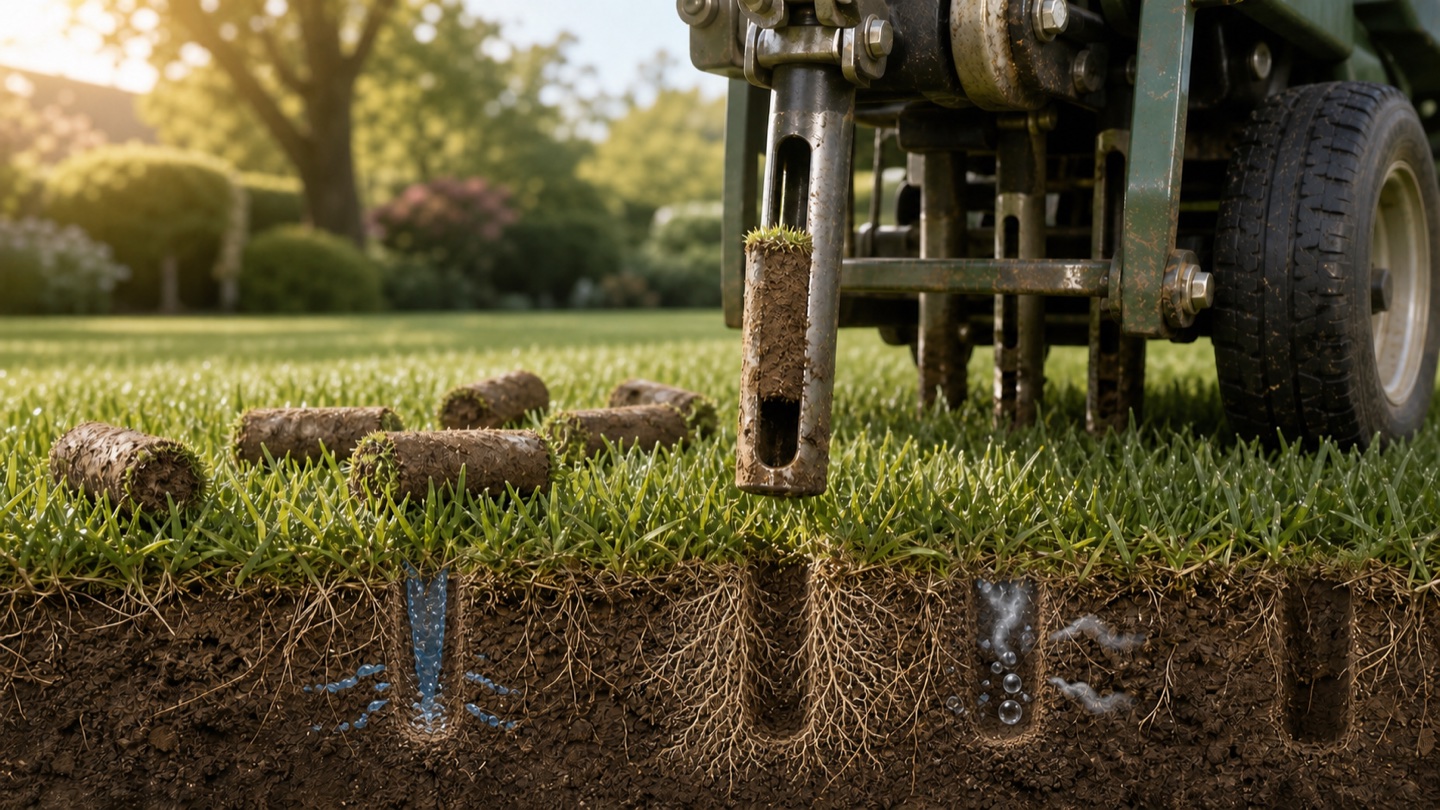
The reason timing matters: every hole is also a wound. Aerate a lawn that is growing hard and recovery starts within days, though you should still leave it at least four weeks of favorable growing weather to finish the job. Aerate a lawn that is stressed, half-dormant, or about to hit its hardest season and it stays thin and open for weeks, and thin, open turf is where weeds get their start.
Core vs. spike: spike aerators (the roller with solid tines, the sandals) poke channels without removing anything, and pressing soil aside can compact the walls of each hole. The effect is short-lived. They are not useless, but when the goal is meaningful compaction relief, pull real cores.
When to aerate
One rule covers every grass: aerate during active growth, at the front edge of your grass's strongest run, with recovery weather still ahead.
Warm-season lawns (bermuda, zoysia, St. Augustine, centipede, bahia): wait for full green-up, then aerate while growth is vigorous, typically late May through July. Your TurfTrigger plan places the task in June, the heart of that window, with months of growing season left to heal. Do not jump early: a lawn still greening up is not yet growing hard enough to make the holes worth it.
Cool-season lawns (Kentucky bluegrass, tall fescue, fine fescue, perennial ryegrass): the strongest growth run starts when summer heat breaks, so the window slides later the hotter your area runs. Late summer to early fall is the extension consensus; your plan places it by grass and zone:
| Zone | Typical plan month |
|---|---|
| 3 to 6 | Late August |
| 7 | September |
| 8 to 9 | October |
Treat the plan month as the starting estimate, not a biological law: USDA zones describe winter cold, and what actually opens this window is the local heat break. Confirm the worst heat is done, the lawn is actively growing again, and at least four weeks of decent growing weather remain. A stressed cool-season lawn still in survival mode should not be aerated yet, and it should not be pushed with fertilizer either.
What about spring? Fall is the better routine window for cool-season turf: growth is strong, and there is no crabgrass pressure waiting in the wings. But spring aeration is a legitimate second choice when the lawn is actively growing and compaction genuinely needs relief this year (Iowa State lists both April and September). One caveat if a pre-emergent is already down: check its label before cultivating (see the interaction section below).
How to do it
- Moisten the soil first. Cores pull cleanly from moist soil and barely at all from dry, while wet soil smears and compacts. If it is dry, water enough to moisten the top 2 to 3 inches, then aerate when the soil is damp but not sticky.
- Flag your sprinkler heads and anything shallow (cable, invisible fence). Tines do not care what they hit.
- Make enough passes for real hole density, roughly 20 to 40 holes per square foot (2 to 3 inches between holes). Two perpendicular passes usually get there; hard soil or wide tine spacing may need more.
- Leave the cores on the lawn. They look rough for a week or two, then rain and mowing break them down, and the soil in them helps digest thatch. Once they have dried, mowing or dragging them speeds the breakdown. Do not haul them off.
- Pair it with the season's work where it fits. If your grass's seeding window is open, aeration day is a natural overseeding day: make enough passes and break up the cores so seed meets soil across the whole lawn, not just in the holes. Feed afterward if a feeding is actually due, not just because the ground is open.
Frequency: match it to the problem. Heavy clay under kids, dogs, and a mower rutting the same path can justify aerating every year, sometimes more. Sandy or lightly used lawns can go two or three years. Probe several moist spots with a screwdriver and read the lawn alongside it: puddling, slow-draining spots, thin traffic paths. If everything slides in easy and drains fine, skip a year.
The pre-emergent question, honestly
A pre-emergent herbicide works as a thin chemical layer in the top of the soil, and the internet is sure that aerating "punches holes in the barrier." The research says otherwise: ordinary core aeration disturbs a small fraction of the treated surface, and university trials found no meaningful loss of crabgrass control from coring after a pre-emergent application (B.J. Johnson's Georgia work aerated at one to four months after application without stimulating crabgrass emergence). So a normal aeration pass is not a reason to expect a weedy summer, and not a reason to schedule an extra herbicide.
Two honest cautions survive that good news:
- The label still governs. Some pre-emergent labels instruct you to cultivate before applying, not after. If the product is already down, read it before you rent the machine. When scheduling is yours to choose, aerate first and apply after: it is the cleaner order.
- Seeding is the real conflict. The same barrier that ignores a coring pass will still stop your grass seed. If you are aerating as part of an overseed, the zone cannot have a standard pre-emergent down: that decision is covered on the overseeding page, and it is the conflict your plan actually manages around.
One grass-specific caution: zoysia recovers slowly. Give a zoysia lawn one mechanical job per year, core aerate or dethatch, whichever it needs more. Healing both in one season is more than its slow, lateral growth reliably manages, and your season plan holds the same line.
FAQ
Should I aerate every spring like the lawn service suggests?▸
If you grow cool-season grass, fall is usually the better window, and an every-spring default is about the service's schedule, not your lawn. Spring still works when the lawn is growing and compaction needs attention this year. Warm-season lawns should wait for full green-up and vigorous early-summer growth. Aerate for a reason, not a ritual.
Can I aerate and overseed the same day?▸
Often, and it pairs well, provided your grass's seeding window is open. Aerate first, seed second, with enough passes and broken-up cores that seed contacts soil everywhere. Do not seed into soil carrying an active pre-emergent unless the label allows it.
Liquid aeration?▸
Some bottled products act as wetting agents and can improve water penetration on some soils, but the published evidence does not support them as a substitute for pulling cores. Nothing in a jug removes a plug of compacted clay.
How does TurfTrigger time this?▸
Your season plan places the aeration month for your grass and zone, at the front edge of your growth run. Treat it as the planned starting point and confirm the gates above: heat broken (cool-season), fully green and growing (warm-season), soil moist, recovery weather ahead. We deliberately do not send an aeration alert: unlike a spray window there is no day it suddenly becomes urgent, so it lives on the plan where a calendar task belongs.
Sources
- Iowa State University Extension, Core Aeration of Lawns (timing, spring-vs-fall, hole density)
- K-State Research and Extension, Aerating Your Lawn (spike vs. core, warm-season window)
- Walter Reeves / University of Georgia turf specialists, Aerate Before or After Pre-emergent (the B.J. Johnson and UGA research that pre-emergent control survives coring)
- Purdue University Turfgrass Science, Pre-emergent timing and soil residual
- University of Missouri Extension, Zoysiagrass Lawns (G6708) (zoysia cultivation and recovery)
- Colorado State University PlantTalk, Liquid Lawn Aeration
See where this lands in your season
Timing beats technique. See the month this task belongs in for your grass on the free grass-and-zone schedules, or enter your ZIP for your soil temperature today and whether the pre-emergent window is open.